




Aluminum Tread Plate Thickness Guide
Apr 27 26
Aluminum tread plates, with their advantages of being anti-slip, lightweight, corrosion-resistant, and easy to process, are widely used in architectural decoration, industrial platforms, truck floors, and ship decks. Thickness directly determines load-bearing capacity, rigidity, cost, and installation effect. So how do you choose the right thickness?
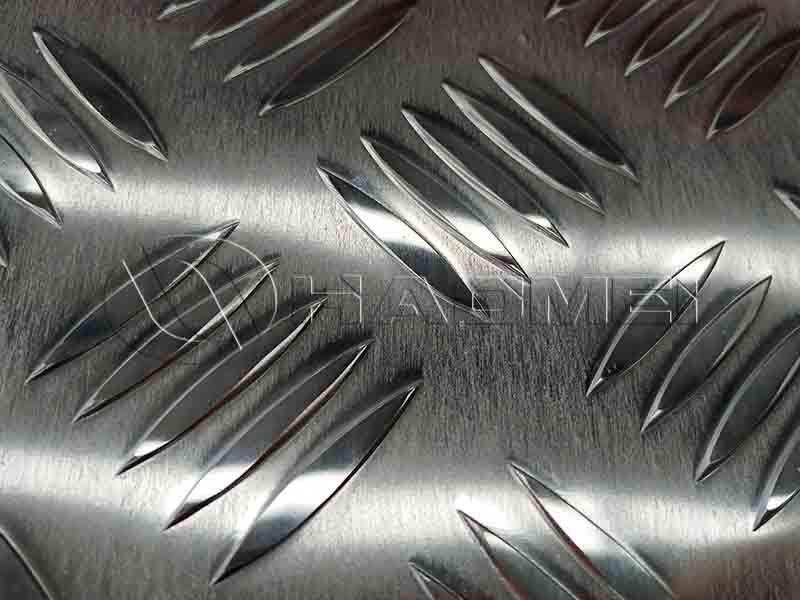
What are the common thicknesses of patterned aluminum sheets?
The mainstream market thickness covers 0.8mm–10mm, with 1.0mm–6.0mm being the most common in stock. Different thicknesses correspond to different applications:
Thin sheets (0.8–2.0mm): Decoration, lightweight anti-slip, appliance housings, curtain wall linings, lightweight treads;
Medium sheets (2.0–4.0mm): Indoor and outdoor stairs, truck floors, lightweight platforms, ship decks, commercial anti-slip flooring;
Thick sheets (4.0mm and above): Heavy-duty industrial platforms, forklift aisles, heavy-duty truck beds, equipment bases, high-load-bearing ramps.
In daily procurement, 2mm and 3mm are the two most widely used and versatile thicknesses, and are the models discussed in this article.
Aluminum Tread Sheet Thickness and Weight Comparison Table (Theoretical Weight per 1㎡)
Thickness(mm) | Weight per 1㎡(kg) | Thickness(mm) | Weight per 1㎡(kg) |
0.8 | 2.17 | 3.0 | 8.13 |
1.0 | 2.71 | 3.5 | 9.49 |
1.2 | 3.25 | 4.0 | 10.84 |
1.5 | 4.07 | 5.0 | 13.55 |
2.0 | 5.42 | 6.0 | 16.26 |
2.5 | 6.78 | 8.0 | 21.68 |
Common Alloy Combinations
1060 Pure Aluminum: Soft, easy to process, moderate rust resistance
✅ Best paired with: 0.8–2.0mm thin plates, used for interior decoration and lightweight anti-slip applications
3003 Rust-resistant Aluminum: Higher strength than 1060, good rust resistance
✅ Best paired with: 1.5–3.0mm, used for indoor and outdoor treads, vehicle bodies, and cold storage
5052 Magnesium-aluminum Alloy: High strength, good corrosion resistance, impact resistance, and marine-grade durability
✅ Best paired with: 2.0–6.0mm, used for industrial platforms, ships, outdoor applications, and heavy-duty applications
5083 High Magnesium Alloy: Heavy-duty, high strength, resistant to seawater corrosion
✅ Best paired with: 3.0mm and above, used for heavy-duty vehicle bodies, ship decks, and heavy-duty industrial platforms
2mm aluminium diamond plate
Core Characteristics
Lightweight: Lightweight design reduces structural load, resulting in lower transportation and installation costs;
Easy to process: Smooth cutting, bending, and punching, suitable for decorative and non-standard customization;
High cost-effectiveness: Lower unit price, suitable for large-area paving;
Moderate load-bearing capacity: Suitable for pedestrian use, light equipment, and light-load vehicle bodies.
Applicable Scenarios
✅ Indoor stair treads, corridor anti-slip, elevator car anti-slip flooring
✅ Appliance casings, decorative curtain walls, partitions, ceiling panels
✅ Light truck cargo box flooring, car foot pedals
✅ Light-load areas on ships, light-duty anti-slip flooring in cold storage
✅ Equipment protective covers, light-duty workbenches.
Aluminium tread plate 3mm
Core Characteristics
Stronger Rigidity: Significantly better resistance to dents and deformation than 2mm, less prone to warping over long-term use;
More Stable Load-Bearing Capacity: Higher even load distribution, suitable for medium load-bearing and high-traffic environments;
Enhanced Durability: Wear-resistant, impact-resistant, and longer service life;
Maximum Versatility: Suitable for indoor and outdoor use, industrial/commercial applications.
Applicable Scenarios
✅ Industrial workshop operating platforms and maintenance passages
✅ High-traffic stair treads in shopping malls/subways/schools
✅ Truck/trailer cargo box floors and toolbox linings
✅ Ship decks and outdoor anti-slip ramps
✅ Garage floors, equipment bases, and medium-duty machinery treads
✅ Anti-slip flooring in coastal/wet environments (better with 5052 alloy).
2mm vs 3mm: Which is the more reasonable choice?
1. Choose according to usage scenario
Choose 2mm aluminium checker plate: Primarily for decoration, pedestrian use, and light loads, without heavy traffic, prioritizing lightweight and low cost;
Choose aluminium chequer plate 3mm: Medium load-bearing capacity, high-frequency foot traffic, outdoor/wet/industrial environments, requiring durability and resistance to deformation.
2. Choose according to support conditions
Small support spacing (≤300mm), dense joists: 2mm is sufficient;
Large support spacing (≥400mm), large-span paving: 3mm is preferred to avoid deformation under foot traffic.
3. Choose according to budget and usage
For large-area paving, limited budget, and light load applications: 2mm is more cost-effective; For critical passageways, long-term use, and reduced maintenance costs: 3mm offers a more worry-free, one-time solution.
4. Material matching recommendations
For light-load decorative applications: 1060/3003 alloy + 2mm; For medium load-bearing/corrosion resistance: 5052 alloy + 3mm (preferred for industrial/marine applications).
https://www.alsheetplate.com/a/aluminum-tread-plate-thickness-guide.html