




Aluminum Circle Plate for Non-Stick Pan Production
Jul 15 26
In the kitchenware market, non-stick pans have become essential cookware in modern households due to their ease of cleaning and reduced oil fumes. The core of a non-stick pan's superior performance, besides the Teflon or other non-stick coating, lies in the quality of the pan's base material—the aluminum disc.
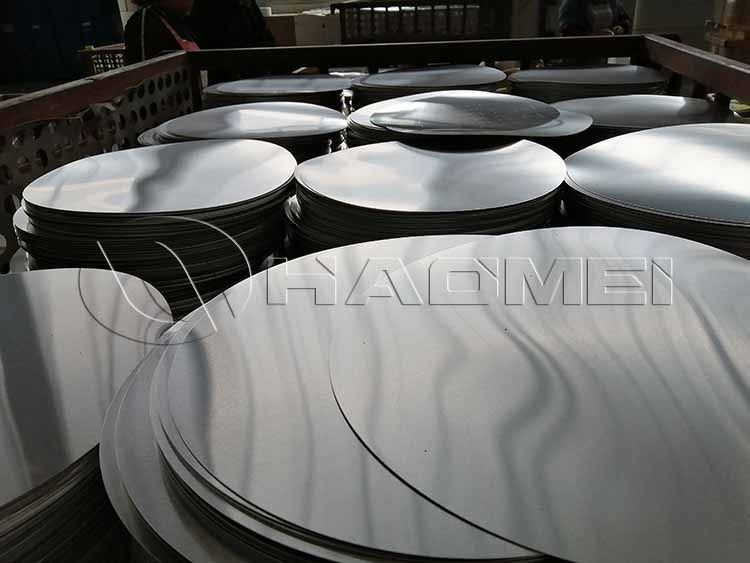
Why is the aluminum disc the preferred base material for non-stick pans?
When choosing a base material for non-stick pans, the aluminum circle plate has irreplaceable advantages over materials like stainless steel and cast iron.
Firstly, aluminum alloy has excellent thermal conductivity, far superior to cast iron and stainless steel, allowing for even heating of the pan and preventing food from burning due to localized overheating, while also reducing oil fumes.
Secondly, aluminum alloy has a low density, making non-stick pans lightweight and easier to use for daily stir-frying and cleaning, especially suitable for the elderly and women.
Furthermore, the aluminum disc has good ductility and plasticity, allowing it to be easily molded into various shapes through stamping and stretching processes, adapting to different kitchen scenarios.
Mainstream Alloy Models
1. 1000 Series Aluminum Alloys
1000 series aluminum alloys belong to the pure aluminum family. Among them, 1050, 1060, and 1100 are the most commonly used models in non-stick pan production. These alloys have an aluminum content of over 99.0% and extremely low impurity content, classifying them as food-grade aluminum alloys that fully comply with safety standards for cookware production.
1050 and 1060 aluminum alloys have purities of 99.5% and 99.6% respectively. Their properties are similar, both possessing excellent thermal conductivity and ductility. They are easy to stamp and form, allowing for the creation of thin pan bodies, making them suitable for producing lightweight, household non-stick pans.
1100 aluminum alloy has an aluminum content of 99.0%. Compared to 1050 and 1060, its impurity content is slightly higher, but its strength is also slightly improved. It has better corrosion resistance and oxidation resistance, making it suitable for producing non-stick pans that require prolonged contact with water and oil, such as saucepans and milk pots. Meanwhile, 1100 aluminum alloy boasts stable processing performance and is less prone to cracking, making it a highly cost-effective choice for household non-stick pans.
2. 3000 Series Aluminum Alloy
The 3000 series aluminum alloy, represented by the 3003 model, is an aluminum-manganese alloy made by adding manganese to pure aluminum. The addition of manganese significantly enhances the alloy's strength while retaining aluminum's advantages of good thermal conductivity and light weight, making it the preferred alloy material for commercial and high-end household non-stick pans.
Compared to the 1000 series, 3003 aluminum alloy has over 30% higher tensile strength and greater hardness. Non-stick pans made from it are less prone to deformation and wear, and can withstand frequent stirring and high-temperature use, making them suitable for commercial settings such as restaurants and hotels, as well as for frequent home cooking. Furthermore, 3003 aluminum alloy exhibits excellent corrosion resistance; even with prolonged contact with acidic or alkaline foods, it is not prone to oxidation or rust, resulting in a longer service life.
3. 5000 Series Aluminum Alloy
The 5000 series aluminum alloy, represented by model 5052, is an aluminum-magnesium alloy. With magnesium added to aluminum, it combines high strength, high corrosion resistance, and good ductility. It is the core material for high-end non-stick pans and is commonly used in the production of high-end frying pans and other similar products.
Core Principles for Alloy Selection in Non-stick Pan Production
For non-stick pan manufacturers, when selecting the round aluminum plate alloys, it is necessary to consider product positioning, usage scenarios, and cost budget, adhering to the following core principles:
Firstly, safety is paramount; food-grade aluminum alloys must be used. Whether it's the 1000 series, 3000 series, or 5000 series, the aluminum discs used in non-stick pan production must meet national food-grade contact material standards to ensure that no harmful substances are released during use, guaranteeing food safety for users.
Secondly, suit the application scenario; select the alloy model according to needs. For manufacturers producing lightweight, portable non-stick cookware with a focus on high cost-effectiveness, the 1000 series aluminum alloy is a good choice. For manufacturers producing commercial non-stick cookware or high-end household products, prioritizing durability and stability, the 3000 or 5000 series aluminum alloys are preferable.
Thirdly, balance manufacturing processes with cost. Different alloys have significantly different processing difficulties and costs. Manufacturers need to select the appropriate alloy model based on their own production capabilities to control production costs while ensuring product quality and enhancing market competitiveness.
https://www.alsheetplate.com/a/aluminum-circle-plate-for-non-stick-pan-production.html