




Common Three Tempers of 1000 Series Aluminum: O, H14, H18
Jul 29 26
Within the aluminum alloy family, 1000 series aluminum is the most basic and widely used category in industrial applications, also known as the pure aluminum series. This series of aluminum materials has an aluminum content of ≥99%, possessing excellent corrosion resistance, electrical conductivity, thermal conductivity, and weldability. It is pure in texture with few impurities, making it suitable for various basic processing and general industrial applications.
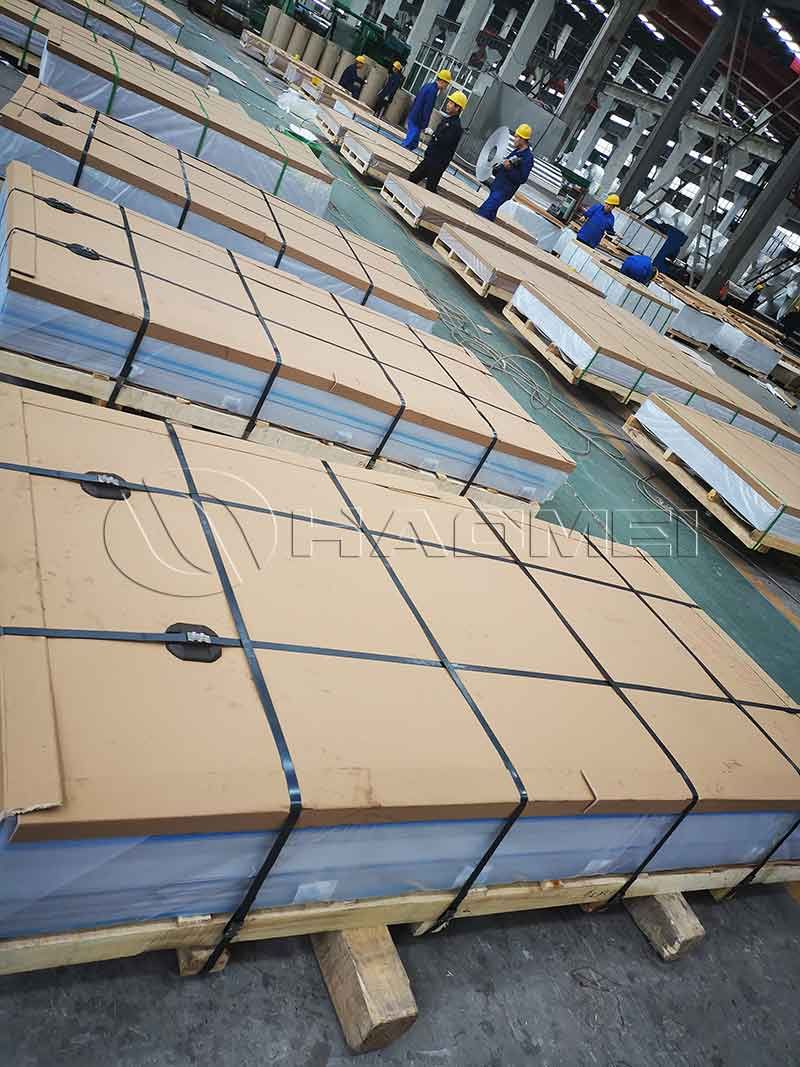
1000 series aluminum tempers
1000 series pure aluminum has no heat treatment strengthening capability; all performance differences stem from the forming process. The two core designations are clearly defined:
1. O temper (annealed): Completely annealed at high temperature, this is the most basic soft state of 1000 series aluminum. The internal grains are completely restored to uniformity, with no work hardening residue. Plasticity reaches its peak, while hardness and strength are at their lowest.
2. H temper (work hardened): Hardened through pure cold rolling without subsequent annealing. The number represents the degree of hardening. H14 is a semi-hard state with balanced hardness and softness; H18 is a fully hard state, representing the highest hardness and strength under conventional work hardening.
Three popular tempers
1. O-temper
The O-temper is the fully softened state of 1000 series aluminum alloys. It involves high-temperature annealing to eliminate internal stresses generated during cold rolling, resulting in a uniform and stable grain structure. Aluminum in this state exhibits extremely high elongation and excellent toughness, capable of withstanding significant bending, stretching, and stamping without easily cracking or deforming. However, its hardness and tensile strength are relatively weak, making it unsuitable for heavy-duty structures.
1050 and 1100 aluminum alloys also have corresponding O-temper versions, commonly used as substrates for deep processing. They are mainly used in various complex forming scenarios, such as kitchenware stretching, lamp housing stamping, precision sheet metal bending, deep processing of thermal insulation aluminum coils, and instrument housings. It is the core raw material for all soft aluminum products.
2. H14 Temper
H14 is the most classic semi-hardened state of the 1000 series. The process involves cold rolling the substrate without full annealing, retaining a moderate work hardening effect. Compared to the O temper, H14 offers significantly improved hardness and strength, along with better surface flatness. Compared to the H18 temper, it retains ample ductility, allowing for regular bending, cutting, and light stamping, balancing structural stability and processing flexibility for the most balanced overall performance.
1050 h14 aluminium is the benchmark material in this temper and one of the most widely traded 1-series aluminum materials. 1050 pure aluminum boasts high purity and a smooth surface, and combined with the semi-hard characteristics of H14, it is perfectly suited for applications such as building insulation aluminum cladding, pipe corrosion protection, general decorative panels, electrical equipment heat sinks, and simple hardware accessories.
It avoids deformation during installation due to excessive softness and prevents bending limitations due to excessive hardness, making it the preferred specification for civilian and light industrial applications.
3. H18 Temperament
H18 is the fully hardened temper of the 1000 series, achieved through high-reduction cold rolling, maximizing work hardening without the need for annealing. Aluminum in this state achieves peak hardness and tensile strength for 1-series aluminum, resulting in a smooth, rigid surface that is resistant to deformation and exhibits excellent wear resistance. However, its plasticity is significantly reduced, making it unsuitable for large-scale bending or stretching; it is only suitable for simple processing such as cutting, punching, and precision cutting.
1100 H18 aluminum is the core representative of industrial hard aluminum. Compared to 1050, 1100 aluminum offers superior forming stability and surface uniformity. With the added hardness of H18, it boasts even stronger structural rigidity.
It is primarily used in applications requiring high flatness, shape retention, and wear resistance, such as industrial curtain wall panels, precision equipment covers, aluminum signs, stamped rigid components, and corrosion-resistant industrial linings. It is suitable for applications where significant deformation is not required and structural stability is paramount.
https://www.alsheetplate.com/a/common-three-tempers-of-1000-series-aluminum-o-h14-h18.html