




Marine Grade Flat Aluminum Plate: 5052/5083/5086 for Shipbuilding & Yacht
Aug 20 26
Among the various types of marine-grade aluminum, the 5000-series aluminum-magnesium alloys—which do not require heat treatment for hardening and offer stable, balanced overall performance—serve as core materials for shipbuilding, luxury yachts, and recreational vessels. Specifically, the 5052, 5083, and 5086 flat aluminum sheets offer the greatest versatility and are the most widely used in the shipbuilding industry.
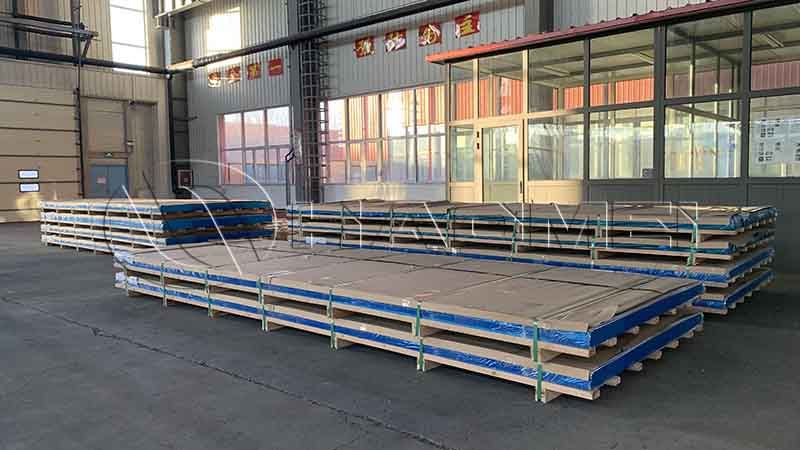
I. Core Shared Characteristics
The 5052, 5083, and 5086 alloys are all standard rust-proof aluminum-magnesium alloys classified as professional marine-grade materials. They offer significant advantages over standard industrial aluminum plates and have long dominated the mainstream market for marine materials.
The primary advantage of these three alloys is their excellent corrosion resistance; the magnesium content allows for the formation of a dense oxide film on the surface, effectively resisting erosion from seawater salinity, humid air, and marine microorganisms. This prevents issues such as hull rusting, material delamination, and leakage, thereby significantly extending the vessel's service life. Secondly, they are lightweight yet high-strength; the density of aluminum is far lower than that of steel, allowing for reduced hull weight, increased cruising speeds, and lower fuel consumption, all while meeting structural load-bearing requirements.
Furthermore, these alloys exhibit excellent welding performance—resisting deformation and cracking after welding—and maintain high weld-seam strength relative to the base metal, making them suitable for critical processes like hull assembly and structural reinforcement. They also possess outstanding low-temperature toughness, remaining resistant to brittle fracture in cold marine environments. They are suitable for various operational scenarios, including coastal, deep-sea, and inland waterway navigation, and all hold classification society certifications, fully complying with shipbuilding safety standards.
II. Comparative Performance Analysis of 5052, 5083, and 5086 Marine Aluminum Plates
1. 5052 Marine Aluminum Plate
Among the three, the 5052 alloy has the lowest magnesium content (only 2.2%–2.8%), offering moderate overall strength and superior formability. Commonly available in O, H32, and H34 tempers, it is a cost-effective, economical choice for marine applications. Highly malleable and easy to process, it can be readily bent and stamped, making it ideal for fabricating complex hull shapes and precision components. It offers excellent resistance to freshwater corrosion but only moderate resistance to high-salinity seawater corrosion and stress corrosion. With a tensile strength of 210–260 MPa, it is suitable only for marine applications involving low loads and mild environments. It is primarily used for non-critical load-bearing components—such as interior structures, decking, cabin bulkheads, porthole fittings, and oil/water storage tanks—in inland fishing boats, small sightseeing vessels, and recreational fishing boats, making it the preferred material for the lightweighting of inland vessels.
2. 5083 Marine Aluminum Plate
With a magnesium content of 4.0%–4.9% and optimized with manganese, the 5083 flat aluminum plate is a high-end marine material offering the highest strength, best seawater corrosion resistance, and superior low-temperature toughness among the three types. Commonly supplied in marine-specific H116 or H321 tempers, it is the designated material for ocean-going and large-scale vessels. It boasts a tensile strength of 320–380 MPa, minimal strength loss after welding, and exceptional impact and deformation resistance, enabling it to withstand the wind and wave forces encountered in complex open-ocean waters.
This plate exhibits excellent resistance to exfoliation and stress corrosion, making it suitable for long-term use in the harsh conditions of the open ocean—characterized by high salinity, high humidity, and significant temperature fluctuations. It does not easily become brittle at low temperatures, making it ideal for polar vessels, ocean-going freighters, and large engineering ships. It is primarily used for critical load-bearing structures such as hulls, bottom plating, side plating, cabin bulkheads, and LNG tanks; it is also the core material for high-end luxury yachts and serves as a benchmark product in the marine aluminum industry.
3. 5086 Marine Aluminum Plate
The 5086 aluminum plate has a magnesium content of approximately 3.5%–4.0%—falling between that of the 5052 and 5083 alloys. Classified as a mid-to-high-end marine aluminum material, it strikes a perfect balance between strength, corrosion resistance, and workability, effectively compensating for the limitations of the other two alloys. It has a tensile strength of 315–380 MPa—approaching that of the 5083 alloy—and offers excellent resistance to seawater corrosion; additionally, it surpasses the 5083 alloy in formability and maintains stable welding performance.
This plate is primarily marketed for small-to-medium-sized coastal vessels and high-end yachts, offering outstanding cost-effectiveness and comprehensive performance that fully meets the requirements for coastal navigation. It is widely used in core and secondary structural components—such as hulls, deck structures, and superstructures—for coastal fishing boats, private and commercial yachts, and small maritime service vessels, making it a mainstream material for upgrading the construction of small-to-medium coastal ships and yachts.
III. Summary of Three Types of Marine Aluminum Plates
5052 Marine Aluminum Plate: Features excellent formability, low cost, and good weldability; its drawbacks include relatively low strength and average resistance to high-salinity corrosion. It is suitable for inland freshwater vessels and small recreational boats, and is commonly used for non-load-bearing components such as interiors, decks, and tanks.
5083 Marine Aluminum Plate: Boasts ultra-high strength, seawater corrosion resistance, excellent low-temperature toughness, and stable welding performance; while it is more difficult to form and higher in price, it has no significant performance weaknesses. It is suitable for the core load-bearing structures of ocean-going cargo ships, engineering vessels, polar ships, and high-end yachts.
5086 Marine Aluminum Plate: Offers balanced performance, high strength, good corrosion resistance, ease of processing, and high cost-effectiveness. It is primarily suited for coastal vessels, private yachts, and small-to-medium maritime service vessels, and is used for main hull structures, decks, and superstructures.