




Differences Between 3105 H14 H16 H18 H24 Aluminum
Mar 31 26
In the aluminum processing industry, 3105 aluminum sheets are widely used in construction, packaging and electronics for their excellent rust resistance, weldability and formability. As a typical 3000 series alloy, their core advantage is that cold working and annealing can adjust their mechanical properties to meet different application needs. Among them, H14, H16, H18 and H24 are the most common—how to choose?
The H-series states are all work-hardened states. A higher number indicates a higher degree of work hardening, resulting in increased strength and hardness, but a corresponding decrease in plasticity and ductility. For the same number, the difference between H1× and H2× is that H2× involves an incomplete annealing process after cold working, balancing strength with improved plasticity, making it more suitable for complex forming processes.
H14 Temper
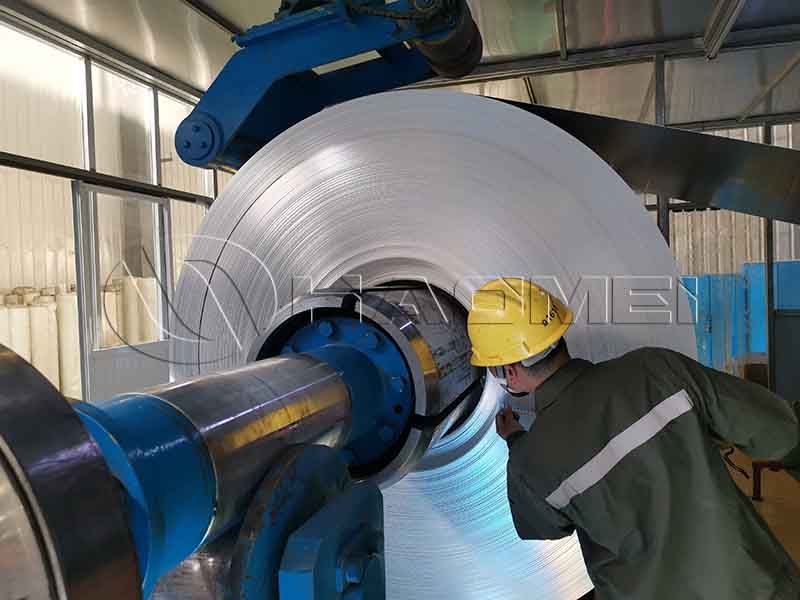
During the 3105 aluminum coil manufacture, H14 temper is "moderate cold working + no subsequent annealing." During cold rolling, the total rolling rate is controlled at a moderate level. External force is used to deform and refine the grains within the aluminum coil, thereby increasing strength. No subsequent annealing is performed, preserving the hardness advantage of cold working.
From a mechanical property perspective, the tensile strength of the H14 temper is approximately 150-200 MPa, the yield strength is approximately 130 MPa, and the elongation is approximately 2%-5%, belonging to a semi-hard state with a balance between strength and plasticity.
Due to its moderate plasticity, it can withstand certain machining without cracking due to excessive hardness, making it widely applicable. For example, 3105-h14 aluminum coils are commonly used in construction for louvers and gutters, packaging for bottle caps and cake tray substrates, as well as lamp holders and small sheet metal parts.
Its advantage lies in its high cost-effectiveness; it does not require complex annealing processes and can meet most conventional forming needs, making it a widely used temper in the market.
H16 Temper
The manufacturing process of the H16 temper further enhances the cold work hardening degree based on H14, also without subsequent annealing. In simple terms, increasing the number of cold rolling passes or increasing the reduction per pass allows for more complete grain deformation within the aluminum coil, resulting in higher strength and hardness.
In terms of performance parameters, the tensile strength of the H16 temper increases to 175-225 MPa, the yield strength is approximately 160 MPa, while the elongation decreases to 1%-2%. Its strength is significantly higher than H14, but its plasticity is further reduced.
This temper of 3105 aluminum coil is more suitable for applications requiring a certain level of strength but with relatively low forming difficulty. For example, it can be used to manufacture bottle caps that need to withstand certain pressure (such as spirit bottle caps), simple metal labels, and small structural supports.
It's important to note that due to its poor plasticity, the H16 temper is not suitable for complex bending or deep drawing processes; otherwise, creases or cracks are likely to occur. Therefore, it's necessary to avoid selecting this temper for applications with high forming requirements.
H18 Temper
The H18 temper represents the highest degree of cold work hardening for 3105 aluminum coils. Manufacturing involves a "maximum cold rolling + no annealing" process, using multiple passes of high-pressure cold rolling to achieve extreme deformation of the aluminum coil's internal grains, resulting in the highest strength and hardness.
Its tensile strength is ≥195MPa, yield strength is approximately 180MPa, and elongation is only about 1%. It is a "hard and brittle" fully hardened state, lacking almost no complex forming capabilities, but exhibiting excellent wear resistance and deformation resistance.
3105-h18 aluminum coils have relatively specific applications, primarily for products requiring extremely high strength and wear resistance without subsequent forming processes. Examples include the casings of precision instruments, small wear-resistant gaskets, the outer protective layer of high-end bottle caps, and metal parts requiring long-term shape stability.
Due to its high processing difficulty, it is only suitable for simple cutting and stamping (non-deep drawing). When selecting H18, it is essential to clearly define your processing technology to avoid product scrap due to insufficient plasticity.
H24 temper
The manufacturing process for the H24 temper differs from the three H1× series mentioned above. Its core principle is "moderate cold working + incomplete annealing." This means it first achieves a hardening level similar to H14 through cold rolling, followed by a low-temperature, short-duration incomplete annealing treatment.
This annealing does not completely eliminate the strengthening effect of cold working but appropriately releases internal stress, refines the grain size, and significantly improves plasticity and ductility while retaining a certain level of strength.
Its mechanical properties are similar to H14, with a tensile strength of approximately 150-200 MPa and a yield strength of approximately 120 MPa, but the elongation is increased to 4%-5%, resulting in better formability than the H14 temper.
3105-h24 aluminum sheet represents the optimal balance between strength and formability, making it suitable for applications requiring complex processing (such as bending, deep drawing, and edge rolling) and high strength. Examples include color-coated aluminum coil substrates, roofing panels, and corrugated sheets in the construction industry; deep-drawn bottle caps and tea canisters in the packaging industry; and prefabricated house wall panels and downpipes.
It is worth mentioning that the H24 condition is also one of the most widely used conditions for 3105 aluminum coils, especially suitable for mass production scenarios with high requirements for processing accuracy and product qualification rate. Welcome to contact us to get aluminium alloy 3105 specification.
https://www.alsheetplate.com/a/differences-between-3105-h14-h16-h18-h24-aluminum.html